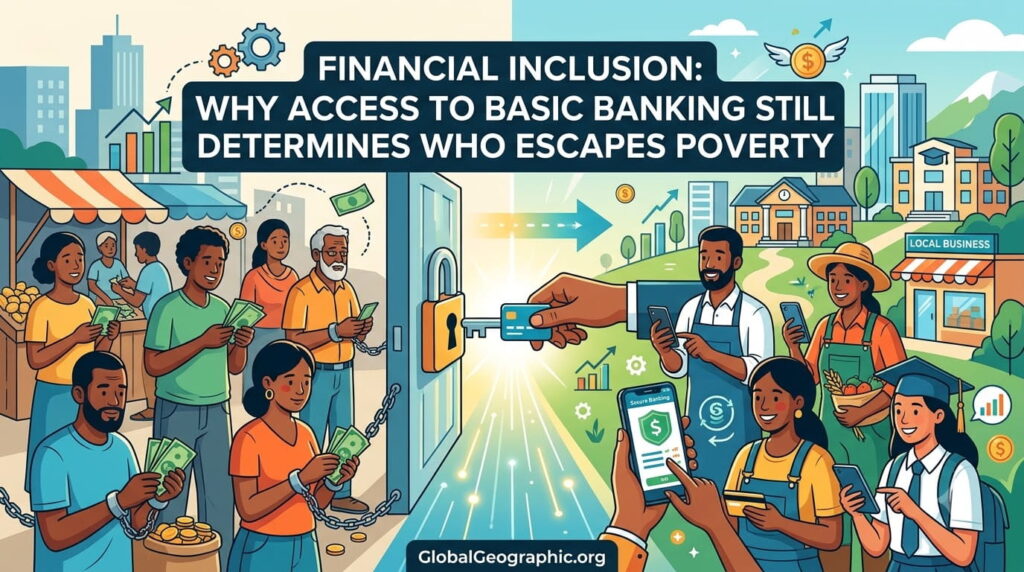
Financial Inclusion: Why Access to Basic Banking Still Determines Who Escapes Poverty
Financial stability is often discussed in terms of income: better jobs, higher wages, and more reliable earnings. Those things matter, but income is only part of the picture. People also need safe and affordable ways to save, receive money, make payments, manage emergencies, and access appropriate financial services.
The SocialWorker Team brings more than 15 years of professional experience in information technology, along with social-work experience in India and the United States. That combination highlights an important point: financial inclusion is not only a banking issue. It is also a question of access, systems, trust, information, and the ability to turn income into lasting financial security.
What Financial Exclusion Means
Being financially excluded does not simply mean not having a bank account. It can also mean having no reliable way to save, difficulty receiving payments safely, limited access to affordable credit, or no practical access to insurance and other financial tools.
These gaps can create a cycle in which households have little room to absorb unexpected costs. A medical expense, a poor harvest, a repair bill, or a period without work can quickly consume available cash.
Formal financial services can help people manage these risks, but access alone is not enough. Products need to be affordable, understandable, secure, and suitable for the people using them.
What Being Unbanked Can Cost a Household
Savings provide a place to keep money for future needs, yet households without secure savings options may find it harder to build an emergency reserve. When a financial shock occurs, they may have to sell assets, borrow from relatives, reduce essential spending, or turn to informal lenders.
Credit can also be difficult. Without access to reasonably priced formal credit, some borrowers rely on informal sources with high interest rates and limited consumer protections. The result can be a debt burden that makes it even harder to build savings or invest in productive activities.
Payment systems matter as well. Digital transfers can reduce the need to carry large amounts of cash and can make it easier for workers, small businesses, and families to receive money from customers, employers, or relatives.
How Financial Inclusion Has Changed
From Microloans to a Broader Set of Financial Tools
Microfinance brought significant attention to small loans for people who were traditionally excluded from formal banking. In some settings, microloans helped entrepreneurs invest in businesses and manage cash flow.
Experience across the sector also showed that loans are not the right answer for every financial problem. Borrowing for consumption, unpredictable income, high repayment pressure, or unsuitable loan sizes can create difficulties.
Modern financial inclusion therefore looks more broadly at savings, payments, insurance, remittances, financial education, and appropriately designed credit. The right service depends on the household’s situation and financial goals.
Mobile Money and Digital Payments
Mobile money has changed how financial services can reach people, especially in places where building a traditional network of bank branches is expensive or impractical.
With a mobile-based financial service, people may be able to store value, transfer money, receive payments, or make purchases without traveling to a bank branch.
Digital systems also create new responsibilities. Providers and communities need to consider fraud prevention, privacy, cybersecurity, digital literacy, service reliability, and the needs of people who are less comfortable with technology.
Community Savings Groups
Community-based savings groups remain useful in areas where formal financial services are limited or where people prefer to start with a trusted local system.
A typical group may involve members contributing a set amount regularly, maintaining records, and providing small loans from pooled savings according to agreed rules.
The strength of these groups often comes from participation and accountability within the community. They can also serve as a practical way to build savings habits and financial knowledge before households begin using more formal financial products.
Where Community Organizations Can Add Value
Banks, mobile operators, and fintech companies provide much of the financial infrastructure, but access does not automatically mean effective use. People may still need help understanding fees, choosing appropriate products, managing budgets, avoiding fraud, and evaluating borrowing decisions.
Community organizations can contribute through financial education, outreach, trust-building, referrals, and support for people who face language, technology, geographic, or administrative barriers.
Financial education is particularly important when new digital services are introduced. A person can have access to a mobile wallet or bank account and still remain financially vulnerable if they do not understand how to protect their account or manage the service effectively.
The Gender Dimension
Financial exclusion does not affect everyone equally. Women in many parts of the world continue to face barriers linked to income, legal systems, social expectations, mobility, documentation, technology access, and control over household resources.
Programs designed around these realities can make participation easier. Examples include accessible account registration, financial education, products suited to irregular incomes, trusted community outreach, and greater access to digital financial tools.
When women have stronger control over financial resources, the benefits can extend beyond the individual to household planning and resilience. The exact effects vary by context, so programs should be measured rather than assumed to have the same impact everywhere.
Financial Inclusion and Technology
Technology can lower the cost of delivering financial services and make them available beyond traditional bank branches. But technology works best when the surrounding system is designed for real users.
Clear interfaces, local-language support, reliable connectivity, transparent fees, strong identity and security processes, and accessible customer support can all affect whether people use a service successfully.
This is where technology experience can be particularly relevant. A financial product is ultimately a system used by people, and systems have to be understandable, dependable, and secure if they are going to produce meaningful results.
How to Measure Financial Inclusion Properly
Counting the number of bank accounts opened or mobile wallets registered is useful, but those figures do not tell the full story. An account that is never used does not provide the same value as an account that helps a household save, receive income, or manage emergencies.
More useful measures include active account use, savings behavior, access to appropriate credit, transaction costs, ability to manage unexpected expenses, continued use over time, and changes in household financial resilience.
Programs should also examine whether benefits are reaching the people most likely to be excluded, including low-income households, women, rural residents, people with limited digital skills, and communities with weak financial infrastructure.
The Next Stage of Financial Inclusion
The next stage is not simply about opening more accounts. The bigger challenge is improving the quality of financial access.
That can mean designing simpler products, improving financial education, reducing unnecessary fees, strengthening consumer protection, expanding services in underserved areas, and making digital finance safer and easier to use.
It also means recognizing that different households need different combinations of tools. One person may need a savings product, another may need insurance, and another may need affordable working capital for a small business.
What Effective Financial Inclusion Can Look Like
Affordable access: Basic financial services should be priced in a way that does not exclude the people who need them most.
Useful products: Savings, payments, credit, and insurance should be designed around real financial needs rather than simply maximizing enrollment.
Financial education: People need practical knowledge about budgeting, saving, borrowing, fees, digital security, and financial decision-making.
Consumer protection: Clear information, transparent pricing, privacy, fraud prevention, and complaint mechanisms help users participate with greater confidence.
Local outreach: Community-based support can help people overcome geographic, cultural, language, and technology barriers.
Long-term measurement: Success should be evaluated through sustained use and improved financial resilience, not only through the number of accounts opened.
Why This Matters for Poverty Reduction
Financial inclusion is not a substitute for jobs, education, healthcare, or social protection. However, it can strengthen the ability of households and small businesses to manage the resources they already have.
A secure place to save can help build a financial buffer. Reliable payments can make transactions easier. Appropriate credit can support productive activity. Insurance can help reduce the financial impact of certain shocks.
These tools do not remove poverty on their own, but they can give people more options when managing everyday finances and responding to unexpected events.
Conclusion
Financial inclusion is ultimately about more than putting people inside the banking system. It is about giving people practical financial tools that are affordable, understandable, safe, and relevant to their lives.
The experience of technology and social-impact work also shows why access and usability need to be considered together. A system may exist, but it creates little value when people cannot reach it, understand it, trust it, or use it safely.
For governments, financial institutions, technology companies, NGOs, and community organizations, the goal should be a financial system that works for people who have historically been left out of it.
Better access to savings, payments, credit, insurance, and financial knowledge can help households become more resilient and improve their ability to plan for the future. That makes financial inclusion an important part of a broader strategy for reducing poverty and expanding economic opportunity.