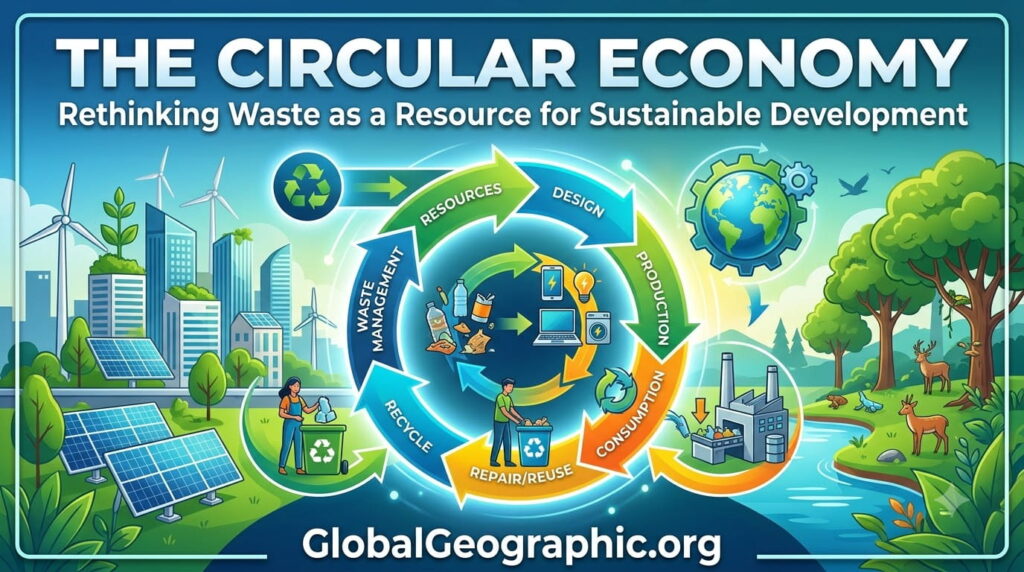
The Circular Economy: Rethinking Waste as a Resource for Sustainable Development
There’s a moment in almost every waste conversation where someone points out the obvious: we don’t actually have a waste problem, we have a design problem. Most of what ends up in a landfill wasn’t destined to become garbage the day it was made — it became garbage because nobody planned for what would happen to it after its first use ended. The circular economy is, at its core, an attempt to fix that oversight before it happens rather than clean up after it.
It’s a term that gets thrown around loosely these days, often reduced to “recycling, but bigger.” That’s a shame, because the actual idea is more interesting and more ambitious than that. A circular economy isn’t just about recovering materials at the end of a product’s life. It’s about designing products, supply chains, and business models from the start so that materials keep circulating — through reuse, repair, remanufacturing, and recycling — instead of flowing in one direction from raw material to landfill.
In corporate technology work, I’ve seen how much easier it is to fix a process at the design stage than to patch it after it’s already running at scale. Retrofitting a broken workflow once thousands of people depend on it is expensive, slow, and usually only partially successful. The same logic applies to physical products and supply chains, and it’s exactly why circular economy thinking has started gaining real traction among NGOs and development organizations, not just manufacturers.
Why the Linear Model Is Running Out of Road
The traditional industrial model — take, make, dispose — worked reasonably well when raw materials felt abundant and the true cost of disposal was largely invisible to whoever was doing the disposing. Neither of those conditions holds anymore. Resource extraction has accelerated well beyond what ecosystems can regenerate, and the downstream costs of disposal — polluted waterways, overflowing landfills, greenhouse gas emissions from decomposing waste — are increasingly being felt by communities that had little say in how the products were designed in the first place.
This isn’t an abstract, someday problem. Electronic waste is now one of the fastest-growing waste categories in the world, driven by short product lifecycles and devices that are often difficult or impossible to repair. Textile waste from fast fashion has followed a similar trajectory. And in many developing regions, the burden of managing waste generated elsewhere — through informal recycling markets, exported electronics, and secondhand goods that arrive already near the end of their usable life — falls disproportionately on communities with the least capacity to manage it safely.
What a Circular Approach Actually Involves
Designing for Longevity and Repair
The most upstream intervention in the circular economy is also the least visible: designing products to last longer and to be repaired rather than replaced. This sounds simple, but it runs directly against a manufacturing model built around frequent replacement cycles. Organizations advocating for “right to repair” policies — which require manufacturers to make parts, tools, and repair information available to consumers and independent repair shops — are pushing against real commercial resistance, because a product that lasts a decade generates less repeat revenue than one that lasts two years.
NGOs have played a meaningful role here, less by manufacturing anything themselves and more by building the evidence base and public pressure that has, in a number of regions, translated into actual repair-rights legislation.
Reuse and Redistribution Networks
Before anything gets recycled, there’s an entire layer of opportunity in simply keeping items in use longer through resale, donation, and redistribution. This is where a lot of grassroots NGO work happens — clothing exchanges, tool libraries, furniture redistribution programs, computer refurbishment initiatives that take retired corporate hardware and get it into schools or community centers rather than a shredder.
To be clear about how these programs typically work: the examples I’m describing here reflect illustrative composites of the kind of initiatives common across the sector, not references to any specific identifiable organization or client engagement. But the pattern holds broadly — a refurbishment program that takes in a steady stream of retired equipment and gets it back into circulation locally tends to create more community value, dollar for dollar, than sending the same material to a recycling facility, simply because reuse preserves far more of a product’s embedded value than breaking it back down into raw materials does.
Materials Recovery That Actually Works
When products do reach the end of their usable life, how they’re processed matters enormously. A lot of what gets labeled “recycling” globally is actually low-value downcycling — plastic bottles turned into lower-grade materials that can only be recycled once or twice more before becoming true waste, rather than genuinely closed-loop recovery.
Building materials recovery systems that actually function — sorting facilities capable of separating complex material streams, processing capacity for materials like electronics and textiles that require specialized handling, and end markets willing to buy recovered material at a price that makes the whole system economically viable — is unglamorous infrastructure work. It rarely generates the kind of imagery that performs well on social media, but it’s the backbone that determines whether a circular economy initiative produces lasting change or just a good headline.
Rethinking Ownership Models
One of the more structurally interesting shifts within circular economy thinking involves ownership itself. Product-as-a-service models — where a company retains ownership of durable goods like appliances, industrial equipment, or even clothing, and customers pay for access rather than outright ownership — create a direct incentive for manufacturers to build products that last, since the company bears the cost of replacement rather than passing that cost on to a customer who simply throws the old item away.
This model is still relatively niche outside a handful of industries, but it points toward something important: circular economy outcomes tend to improve fastest not when consumers are asked to behave more responsibly, but when the underlying business incentives are restructured so that durability and repairability become profitable rather than a drag on revenue.
The Development Angle That Often Gets Missed
In the middle of most circular economy conversations, the focus tends to stay on wealthy consumer markets — repair rights in Europe, resale platforms in North America, corporate sustainability pledges from major manufacturers. What gets less attention is how circular economy principles intersect with economic development in lower-income regions, where informal recycling and repair economies have existed for generations, often without any of the institutional support or investment that formal circular economy initiatives receive elsewhere.
Informal waste pickers, repair technicians, and secondhand goods traders already perform much of the practical work of a circular economy in many parts of the world — recovering materials, extending product lifespans, keeping usable goods in circulation. What’s typically missing isn’t the underlying practice but the infrastructure, safety standards, and fair market access that would let this existing work scale safely and sustainably rather than remaining precarious and under-resourced.
NGOs positioned to bridge that gap — connecting informal recovery networks with formal supply chains, providing safety training and equipment, or helping negotiate fairer pricing with downstream buyers — are often creating more circular economy value per dollar invested than programs that try to build entirely new systems from scratch in places where an informal one, however underdeveloped, already exists.
Measuring Whether It’s Actually Working
As with most sustainability work, it’s easy to measure activity and much harder to measure outcomes. Tons of material diverted from landfill is a common metric, but it doesn’t distinguish between genuine circularity — material that’s reused or recycled into equivalent-value products — and downcycling that simply delays disposal by one additional step.
More meaningful indicators tend to look at material flow over multiple cycles: How many times does a given material get reused before it’s truly discarded? Is the overall volume of virgin material extraction for a given product category declining over time, not just the volume being recycled? Are repair and refurbishment businesses growing as a share of the local economy, which would suggest the shift is structural rather than a temporary grant-funded initiative?
These are harder numbers to gather and slower to show movement, but they’re the ones that actually indicate whether a circular economy initiative is changing underlying material flows or just adding a recycling step onto an otherwise unchanged linear system.
Where This Leaves Us
The circular economy isn’t a single program or technology — it’s closer to a design philosophy that has to be applied at every stage, from how a product is first conceived to how it’s eventually taken apart and its materials recovered. That makes it slower and less tidy than a single cleanup initiative or awareness campaign, but it also makes it more durable when it actually takes hold, because it changes the underlying economics rather than asking people to consistently make a more inconvenient choice.
For NGOs and development organizations, the opportunity sits less in reinventing this work from scratch and more in strengthening what already exists — supporting repair economies, building materials recovery infrastructure where it’s missing, and pushing for the policy changes that make circularity the default rather than the exception. None of that is as visually compelling as a single dramatic cleanup, but it’s the kind of work that, cumulatively, changes how much waste gets generated in the first place.
About the Author
Sameer is a Business Analyst and Salesforce Implementation Specialist with over 15 years of experience helping organizations translate complex requirements into scalable solutions. He writes for GlobalGeographic.com on technology, sustainability, and the practical challenges facing global NGOs today.