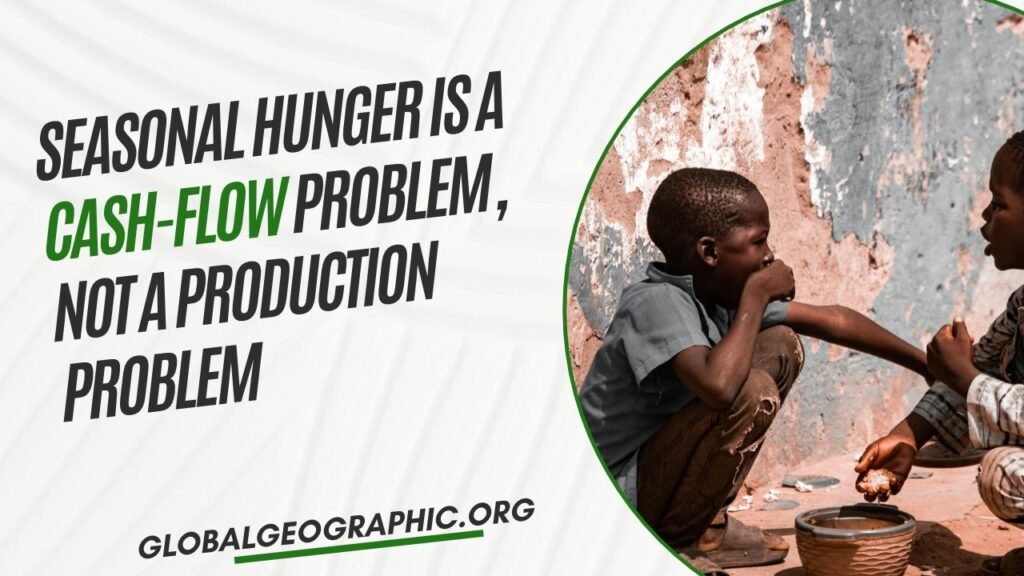
Seasonal Hunger Is a Cash-Flow Problem, Not a Production Problem
Hunger is often discussed as a problem of insufficient food production. When families struggle to eat, the usual responses include improving agricultural productivity, distributing better seeds, expanding irrigation, introducing modern farming techniques, and encouraging farmers to grow more crops. These interventions are important, particularly in regions where agricultural output is affected by poor infrastructure, unpredictable rainfall, declining soil quality, and limited access to agricultural resources. However, they do not fully explain why hunger continues in farming households even after a reasonably successful harvest.
A household can produce enough food during one part of the year and still experience serious food shortages several months later. The problem is not necessarily that food was never available. It may be that the household could not afford to retain it.
For many smallholder farmers, harvest time is also the period when financial obligations become most pressing. Loans need repayment, agricultural inputs must be purchased for the next season, labourers expect wages, household expenses have accumulated, and informal creditors may demand their money. Selling harvested crops becomes an immediate way to generate cash. Unfortunately, this often happens when many farmers are selling simultaneously, creating downward pressure on market prices.
As the months pass, household food stocks decline. Families that sold their produce at relatively low prices may eventually need to purchase the same food at considerably higher prices. By then, their cash reserves may already be exhausted. Agricultural wages may also be unavailable because fewer farming activities take place during certain periods.
This creates a seasonal cycle in which households move from temporary food availability to financial pressure and then to food insecurity.
The distinction matters because producing more food does not automatically give a household greater control over when it sells, how much it retains, or whether it can afford food during the months between harvests.
From a social work perspective, seasonal hunger must therefore be understood through household economics, access to credit, employment opportunities, storage infrastructure, and the practical conditions under which families make financial decisions. The central question is not simply whether enough food has been produced, but whether households can maintain access to it throughout the year.
The Harvest Paradox: Having Food Does Not Mean Having Financial Security
Agricultural households experience income differently from households receiving regular monthly salaries. Their earnings are often concentrated around harvesting periods, while expenses continue throughout the year.
A farmer may spend several months preparing land, purchasing seeds and fertilisers, arranging irrigation, managing crops, and paying agricultural labourers before receiving any meaningful income. Even when the harvest is successful, the money received from selling crops must cover several competing requirements.
These may include repaying loans, purchasing inputs for the next agricultural cycle, paying outstanding household debts, meeting medical expenses, supporting children’s education, maintaining equipment, and purchasing essential household goods.
The apparent income generated by a harvest can therefore be misleading. A household may receive a substantial payment after selling its produce but retain very little once its obligations have been met.
Consider a general situation in which a small farming household harvests enough grain to meet its expected annual consumption requirements. However, the household has borrowed money to finance cultivation and needs to repay the lender immediately after harvesting. It also requires cash for school expenses and preparations for the next planting season.
Selling most of the grain becomes a practical financial decision, even if the family knows that it will need to purchase food later.
The difficulty is that the household is exchanging a relatively stable physical asset for cash at a time when market conditions may not be favourable.
This is the harvest paradox: the period when food is most readily available can also be the period when farming households have the least bargaining power over its sale.
The problem becomes more serious when farmers have limited access to market information, transport, alternative buyers, or collective selling arrangements. Under these conditions, accepting a lower price may be the only immediately available option.
Why Farmers Sell When Prices Are Low
Agricultural markets are influenced by seasonal supply. When large numbers of farmers harvest similar crops around the same time, the market receives a significant volume of produce within a relatively short period.
Unless demand increases at the same rate, prices can decline.
This is not necessarily evidence of unfair trading. It is partly a structural feature of agricultural markets in which production is seasonal but consumption continues throughout the year.
Farmers face an additional disadvantage because their financial needs are often concentrated around the same period.
A household with outstanding debt cannot always wait for better prices. A farmer who needs money for the next crop cannot necessarily retain the current harvest for several months. Similarly, a household facing medical expenses or school fees may have little choice but to sell immediately.
Storage could potentially reduce this pressure, but storage is not simply a matter of having an empty room or a few containers.
Grain must be protected from moisture, insects, rodents, contamination, and deterioration. Safe storage requires appropriate infrastructure, maintenance, knowledge, and sometimes additional treatment. For households with limited resources, these requirements create costs that cannot always be ignored.
There is also an opportunity cost. Grain kept in storage cannot immediately be converted into money for other expenses.
A farmer might understand that prices could improve later but still decide that immediate cash is more valuable than a potentially higher future selling price.
This decision should not be interpreted as poor financial awareness. It reflects the limited choices available to a household managing several urgent responsibilities with uncertain future income.
Storage Is an Economic Resource, Not Just Agricultural Infrastructure
Discussions about reducing post-harvest losses often focus on storage facilities as a technical intervention. While better infrastructure is essential, the social and economic function of storage deserves equal attention.
Storage allows a household to separate the timing of production from the timing of consumption and sale. Instead of selling everything immediately after harvesting, farmers may retain some produce for household use and release the remaining quantity when market conditions are more favourable.
However, the ability to do this depends on more than physical storage capacity.
First, households need enough cash to meet immediate obligations without selling all their produce. Second, storage must be affordable and accessible. Third, farmers need confidence that stored produce will remain safe and retain its market value.
Smallholder farmers may face particular difficulties because the cost of constructing and maintaining individual storage facilities can be high relative to the quantity of produce they retain.
Community storage arrangements, cooperative warehouses, professionally managed storage facilities, and accessible grain banks can offer alternatives.
Such arrangements can reduce the need for every household to maintain separate infrastructure. They may also create opportunities for collective marketing, better inventory management, and improved bargaining power.
Nevertheless, community storage systems require transparent management. Farmers must understand how their grain is recorded, protected, withdrawn, and valued. Questions about ownership, storage charges, quality standards, and responsibility for losses must be addressed clearly.
A poorly managed storage facility can create another source of financial uncertainty rather than solving the original problem.
There is also an important distinction between storing grain for household consumption and storing it for commercial sale. These purposes are related but not identical.
A household reserve should primarily protect food availability. Commercial storage is intended to improve selling decisions. Programmes that focus exclusively on market prices may overlook the immediate nutritional needs of families.
Effective storage interventions must therefore consider both household food security and agricultural income.
Credit Timing Can Determine Whether a Family Eats Properly
One of the most important mechanisms behind seasonal hunger is the timing of credit.
Small farmers frequently need financial support before they receive income from cultivation. They may borrow for seeds, fertilisers, irrigation, equipment, transportation, and labour.
The repayment schedule can determine how much of the harvest remains available to the household.
When repayment is demanded immediately after harvesting, farmers may be forced to sell produce regardless of market prices. This is particularly difficult when the lender has significant bargaining power or when the loan carries high interest costs.
Informal borrowing can make the situation more complicated. Some households depend on local moneylenders, traders, landlords, or other individuals who provide credit when formal institutions are inaccessible.
These arrangements can be useful when money is urgently required. However, they may also involve unfavourable repayment conditions, dependence on a particular buyer, or pressure to sell produce at predetermined prices.
The problem is not simply that farmers borrow money. Agricultural production requires working capital, and credit is often necessary.
The more important issue is whether repayment conditions match the actual income cycle of the borrower.
A household earning most of its income once or twice a year cannot always manage repayments designed around regular monthly salaries.
Financial institutions and agricultural lending programmes need to recognise this difference. Flexible repayment schedules, seasonal credit products, emergency credit facilities, and transparent lending conditions can reduce the pressure to liquidate food stocks immediately after harvest.
Access to formal credit also matters because it may reduce dependence on expensive informal borrowing.
However, simply increasing loan availability is not sufficient. If loans are poorly designed, they can increase household liabilities without improving income stability.
Credit should be evaluated according to whether it helps households manage production costs and consumption needs without creating an unsustainable repayment burden.
The Wage Gap Between Agricultural Seasons
For landless agricultural labourers and small farming households that depend partly on wage employment, seasonal hunger has another dimension.
Agricultural employment is not distributed evenly throughout the year.
Demand for labour may increase during land preparation, sowing, weeding, harvesting, and other labour-intensive activities. Between these periods, employment opportunities can decline.
A household may receive several days or weeks of agricultural work during busy periods but struggle to find consistent employment during the months that follow.
This creates a mismatch between the timing of household expenses and the availability of wages.
Food, cooking fuel, transport, healthcare, school expenses, and other essential costs continue even when agricultural work becomes scarce.
The situation is particularly difficult for households without land or with only a small agricultural holding. They may not retain enough grain from their own production and must purchase most of their food from the market.
If food prices increase during the lean season while employment opportunities decline, two pressures occur simultaneously.
Families have less money available, and the cost of maintaining basic consumption becomes higher.
Women often experience these pressures in additional ways. They may combine agricultural work with unpaid domestic responsibilities, childcare, water collection, cooking, and care for older family members. Their ability to travel for employment or accept work outside the village may be limited by household responsibilities, transport availability, and safety concerns.
Seasonal employment programmes, rural public works, skill development linked to actual labour demand, and opportunities for supplementary income can help address these gaps.
However, the timing of such programmes is important. Employment support delivered after a period of severe food shortages may not prevent the problem.
Income support and employment opportunities need to be available when agricultural wages are declining and household food stocks are becoming insufficient.
Why Food Prices Become a Greater Burden During Lean Months
The lean season is particularly difficult because households may face rising food expenditure at the same time that their income declines.
After harvesting, farmers often have access to their own produce or can purchase food when market supplies are abundant. As household stocks are consumed, dependence on market purchases increases.
The amount of money required to maintain the same level of food consumption may also increase when prices rise.
This creates a double financial burden.
A household that previously managed its food requirements through a combination of retained grain and limited purchases may now need to spend cash on nearly all its food requirements.
When income is insufficient, families begin adjusting their consumption.
These adjustments may include purchasing cheaper food, reducing the variety of meals, consuming smaller quantities, delaying purchases, or prioritising some household members over others.
Such decisions are not merely financial calculations. They can have consequences for nutrition, health, education, and household relationships.
Children may receive less dietary diversity. Women may reduce their own food consumption to ensure that other family members eat. Older people and individuals requiring special diets may face additional difficulties.
The effects can continue even after the next harvest arrives.
Poor nutrition can affect physical health, concentration, learning, and the ability to undertake demanding work. A household experiencing repeated periods of food insecurity may find it increasingly difficult to maintain its income-generating capacity.
Seasonal hunger is therefore not an isolated event. It can reinforce the economic conditions that make future food insecurity more likely.
Why Growing More Food Does Not Solve the Entire Problem
Increasing agricultural productivity remains important. Better seeds, irrigation, soil management, climate-resilient farming, and access to agricultural knowledge can improve production and reduce vulnerability to crop failure.
However, production-oriented programmes cannot independently resolve a cash-flow problem.
If a farmer produces more grain but remains unable to store it safely, access affordable credit, or obtain reasonable market prices, the underlying financial pressure remains.
In some circumstances, higher production may even increase the amount of produce that a household needs to sell immediately to meet outstanding obligations.
Similarly, expanding agricultural markets does not automatically guarantee that small farmers benefit from better prices. Market access depends on transportation, market information, quality standards, bargaining power, competition, and the availability of alternative buyers.
The distinction between food availability and food access is essential.
Food availability concerns whether sufficient food exists within a region or market. Food access concerns whether households have the economic and practical means to obtain it.
A region can produce substantial quantities of grain while particular households experience hunger because they lack purchasing power.
This is why food security programmes need to examine the entire household economy rather than treating agricultural output as the only relevant indicator.
Designing Interventions Around the Agricultural Calendar
A practical response to seasonal hunger should begin with an understanding of when households earn, spend, borrow, repay, and experience food shortages.
An intervention that ignores these patterns may be well designed on paper but poorly timed in practice.
For example, agricultural credit should ideally be structured around expected cultivation and income cycles. Repayment conditions should avoid creating unnecessary pressure to sell food immediately after harvest.
Storage facilities should be available before harvesting begins, not introduced after households have already sold their produce. Farmers also need information about storage costs, quality management, market prices, and the risks associated with delaying sales.
Public food distribution systems can provide an important safety net, particularly for households that cannot retain sufficient grain for their annual consumption. Their effectiveness depends on reliable supplies, accessible distribution points, accurate beneficiary records, and the ability of eligible households to obtain entitlements without excessive administrative difficulty.
In India, the Public Distribution System and the National Food Security Act provide an established framework for supporting access to subsidised food grains. However, formal eligibility does not always translate into uninterrupted access. Documentation problems, migration, biometric authentication difficulties, awareness gaps, and distribution-related barriers can affect households differently.
Social protection programmes must therefore be assessed not only by their official coverage but also by whether food actually reaches households during periods of greatest need.
Employment programmes can provide another layer of protection. Rural employment opportunities are particularly valuable when agricultural demand for labour declines. Their timing, availability of work, payment reliability, and accessibility for women are important considerations.
Local organisations, community institutions, cooperatives, and social workers can contribute by identifying recurring seasonal difficulties, helping households understand available entitlements, supporting access to services, and communicating implementation gaps to relevant authorities.
The objective should not be to replace farmers’ economic decisions with external instructions. It should be to improve the conditions under which those decisions are made.
Measuring Food Security Beyond Annual Production
One weakness in many discussions about agricultural development is the tendency to measure success through annual production, yield improvements, or total market arrivals.
These indicators provide useful information, but they cannot independently reveal whether households experience hunger during particular months.
A better assessment would examine seasonal patterns.
How much grain does a household retain after harvesting? How long does its stored food last? At what point does it begin purchasing grain from the market? Does it borrow money for food? Are there months when agricultural employment becomes unavailable? Does the household reduce meal quantities or dietary diversity before the next harvest?
These questions help identify the financial mechanisms behind food insecurity.
Monitoring should also consider differences between landowners, tenant farmers, agricultural labourers, women-headed households, migrant workers, and households with limited productive assets.
Their experiences may differ considerably even within the same agricultural community.
For instance, a landowning household may face pressure to sell its harvest, while a landless household may depend entirely on wages to purchase food. Treating both groups as having the same seasonal vulnerability can result in interventions that fail to address their actual needs.
Local seasonal assessments can help governments and development organisations identify when food assistance, employment support, credit access, and market interventions are most necessary.
The value of this approach is that it shifts attention from how much food a region produces to how reliably different households can access food throughout the year.
Conclusion: Food Security Requires Financial Security
Seasonal hunger demonstrates why agricultural production and household food security cannot be treated as identical outcomes.
A successful harvest may improve regional food availability, but it does not automatically protect farming families from debt, low selling prices, seasonal unemployment, rising food costs, or inadequate storage.
For many households, the difficulty lies in the gap between receiving income and needing to spend it.
They may sell food when prices are low because debts and household expenses cannot wait. They may purchase the same food later at higher prices because their own stocks have been exhausted. They may also experience reduced employment opportunities precisely when their dependence on market purchases becomes greatest.
These pressures are connected. Addressing only one part of the cycle is unlikely to provide lasting relief.
A more effective approach combines affordable and appropriately timed credit, reliable storage, improved market access, seasonal employment, accessible public food distribution, and household-level food security monitoring.
It also requires recognising that different groups experience the agricultural calendar differently. A small farmer, a tenant cultivator, a landless labourer, and a woman managing unpaid care responsibilities may face entirely different constraints.
From a social work perspective, the important responsibility is to look beyond the visible shortage of food and understand the economic conditions that produce it.
Awareness about nutrition cannot compensate for an empty household budget. Agricultural training cannot solve a repayment schedule that forces immediate distress sales. A storage facility cannot help families that cannot afford to keep their grain inside it.
The underlying issue is whether households have enough financial flexibility to make food available when they need it, rather than only when their crops are harvested.
Agricultural development should therefore be judged not only by how much food farmers produce, but also by whether they can retain, sell, purchase, and consume that food on reasonable terms throughout the year.
A good harvest should reduce hunger for the entire year, not merely provide a few months of relief.
Disclaimer
This article presents a general analysis of seasonal hunger, agricultural household finances, and rural food security. It does not describe specific field projects, individual beneficiaries, or unpublished research conducted by the Social Worker Team. Household circumstances, agricultural markets, and government programme implementation vary across regions. The discussion is intended to encourage a broader understanding of the economic and structural factors influencing seasonal food insecurity.